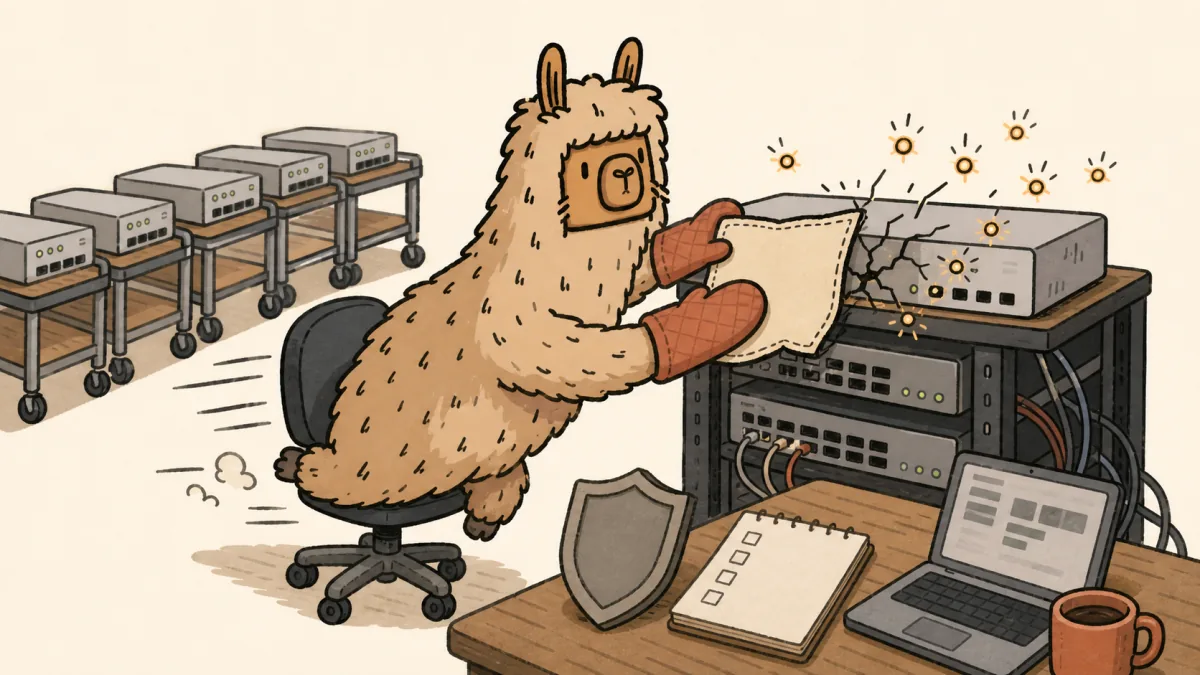
Kaseya MDR vs Huntress for MSPs: Bundle Math and Cleanup Scope

Kaseya MDR vs Huntress is not really a product fight. It is a service-design fight.
MSPs are deciding how security work gets packaged, priced, monitored, escalated, documented, and defended when a client asks what happened. Kaseya's pitch is the bundle: endpoint management, security, backup, automation, and MDR inside the Kaseya 365 Endpoint story. Huntress' pitch is the focused managed-security layer: endpoint, identity, SIEM, awareness, and posture products with a 24/7 SOC attached.
Both can be useful. Both can become expensive shelfware if the MSP does not define the operating model. The useful question is, "Which stack lets us prove response quality, bill the service cleanly, and name the cleanup owner before the incident?"
Quick answer: should MSPs choose Kaseya MDR or Huntress?
MSPs should choose Kaseya MDR when the client already fits the Kaseya 365 operating model and the MSP wants a bundled endpoint, Microsoft 365, firewall, PSA, and SOC workflow inside the Kaseya stack. Choose Huntress when the MSP wants a focused managed-security layer with transparent per-product pricing, broad PSA and RMM integrations, and stronger separation from the RMM vendor.
| Decision area | Kaseya MDR | Huntress |
|---|---|---|
| Core appeal | Bundled MDR tied to Kaseya 365 Endpoint and Kaseya operations | Focused managed security products sold separately |
| MSP fit | Kaseya-heavy shops that want fewer vendor relationships | MSPs that want security separate from their RMM and PSA stack |
| Pricing conversation | Bundle value, endpoint economics, and which Kaseya tier includes MDR | EDR plus any needed ITDR, SIEM, SAT, ISPM, or other modules |
| Main risk | Buying the bundle, then failing to prove response quality and cleanup scope | Adding separate SKUs, then underpricing the MSP labor around them |
| Client proof question | What did the SOC do, where did it ticket, and what did we clean up? | Which Huntress products were active, what did the SOC handle, and what stayed with us? |
Scopable is relevant here because this is where many MSPs lose money: the technical stack is chosen before the scope is priced. Scopable helps MSPs turn assessment findings, client responsibilities, response assumptions, and renewal recommendations into quote-ready scope. start your Scopable free trial.
The comparison MSPs should actually run
Vendor pages make this look like a coverage contest. Kaseya's comparison page says Kaseya MDR includes endpoint and Microsoft 365 coverage in the core MDR offer, supports mixed EDR environments, and ties security events into the Kaseya IT operations stack. Huntress' Managed EDR page says it provides endpoint detection and response across Windows, macOS, and Linux, backed by a 24/7 AI-assisted SOC and active remediation.
Those claims matter, but an MSP needs to ask five less glamorous questions:
- Coverage: Which attack surfaces are actually monitored under the SKU the client is buying?
- Workflow: Where does the alert become a ticket, who owns the ticket, and who has authority to contain?
- Proof: What evidence can the MSP show during a QBR, renewal, insurance review, or post-incident meeting?
- Pricing: Is the service priced as a bundled endpoint margin play, a security add-on stack, or a separate managed offering?
- Cleanup: After containment, who removes persistence, patches the root cause, rebuilds the endpoint, handles identity reset, and writes the client-facing explanation?
If the MSP cannot answer those questions, the vendor choice is premature.
Coverage: endpoint is only one part of the promise
Kaseya MDR and Huntress overlap at endpoint security, but the packaging differs.
Kaseya says Kaseya MDR monitors endpoints, Microsoft 365, and firewalls, with continuous analyst monitoring, AI-driven correlation and triage, PSA ticketing, ransomware and malware prevention, and security performance reports. Kaseya also positions MDR as part of Kaseya 365 Endpoint, where the Pro tier includes RMM, patching, antivirus, EDR, ransomware detection, endpoint backup, and MDR or SOC coverage.
Huntress separates the pieces more visibly. Huntress Managed EDR covers endpoint detection and response. Huntress says its Managed Microsoft Defender capability can manage Microsoft Defender Antivirus at no additional cost when paired with Huntress EDR, and integrates with Microsoft Defender for Endpoint, Defender for Business, and Defender for Endpoint for macOS. For identity, Huntress sells Managed ITDR, which it describes as identity protection for Microsoft 365 and Google Workspace, with 12 million plus identities protected, a listed sub-5 percent false positive rate, and a listed 3 minute mean time to respond.
Kaseya's story is easier to sell as one operating stack if the MSP is already committed to Kaseya. Huntress' story is easier to explain as a modular managed-security layer. Neither framing is automatically better.
The worst version is pretending endpoint coverage equals managed security. Endpoint coverage answers where signals come from. Managed security answers who reviews them, who can act, who documents the result, and who cleans up the business impact.
Bundle math: cheap is not the same as priced correctly
Kaseya 365 Endpoint is designed to make bundle math attractive. Kaseya says Endpoint Pro includes seven components across manage, secure, and backup functions, while Endpoint Express excludes MDR or SOC. Its FAQ says new customers without current components must start with at least 50 endpoints, and the backup component includes 5 TB of shared storage before additional charges apply.
That matters for MSP packaging because Kaseya can make the marginal cost of MDR feel lower when the client is already moving into the broader Kaseya 365 endpoint bundle. If the MSP can replace multiple tools, standardize operations, and show clear margin improvement, the bundle may be rational.
Huntress makes the math more explicit by product. Its pricing page currently lists EDR at $8.99 per endpoint for 50 endpoints, ITDR at $4.80 per identity for 50 identities, SIEM at $4.00 per source for 50 sources, SAT at $2.08 per learner, and ISPM at $4.00 per identity. Huntress also notes that pricing includes the security expertise of its 24/7 SOC, but does not include deployment, integration, or day-to-day operational and portal management that partners can provide.
That note is the part MSPs should underline.
Vendor pricing is not client pricing. The client is also paying for assessment, deployment, escalation design, ticket review, reporting, client communication, remediation coordination, and renewal proof. If those tasks are not scoped, they become unpaid labor.
A good MSP comparison should show two numbers:
| Cost bucket | What to include |
|---|---|
| Vendor cost | Endpoint, identity, SIEM source, awareness, posture, backup, minimums, contract terms, and bundle discounts |
| MSP operating cost | Deployment, policy setup, PSA integration, escalation rules, SOC handoff, client reporting, remediation labor, QBR evidence, and renewal packaging |
Kaseya may win the bundle math for a Kaseya-standardized MSP. Huntress may win the clarity math for an MSP that wants security separated from the infrastructure platform. The answer changes if the MSP prices its own work honestly.
SOC proof: the client does not care who saw the alert first
Kaseya says its MDR includes a 24/7 SOC, AI-augmented triage, direct phone access to SOC analysts, and response actions such as device isolation, account lock, session revocation, and mass isolate and restore. Huntress says its Managed EDR includes a 24/7 AI-assisted human SOC, active remediation, ransomware canaries, and an 8 minute mean time to respond for EDR.
Good. Now make it operational.
A client does not want a tour of the SOC. They want proof that someone made the right call fast enough and that the MSP knew what to do next.
Use this SOC proof checklist before selling either stack:
| Proof area | What the MSP should verify |
|---|---|
| Alert validation | What counts as true positive, false positive, suspicious, contained, or informational? |
| Authority | Who may isolate an endpoint, disable an account, revoke sessions, or start mass containment? |
| Ticket record | Which PSA gets the ticket, what fields are populated, and what evidence attaches automatically? |
| After-hours flow | Who gets called, who gets paged, and what happens when the client contact is unreachable? |
| Client report | What does the client see after the incident, and is it written for operators or executives? |
| Follow-up quote | What cleanup or hardening work becomes a billable recommendation after containment? |
Sophos' 2025 ransomware research found exploited vulnerabilities at 32 percent and compromised credentials at 23 percent as perceived technical root causes among ransomware victims. The same report said ransomware recovery cost an average of $1.53 million, excluding ransom payment. That is why cleanup scope matters. The painful part is often not the first alert. It is the messy work after containment.
A SOC can contain. The MSP still has to make the client whole enough to operate.
PSA and RMM fit: tickets beat portals
Kaseya has an obvious advantage for Kaseya-heavy shops. Its 2026 MDR provider guide describes native PSA integration with Autotask and Kaseya BMS, plus RMM deployment through Datto RMM and Kaseya VSA. Kaseya MDR also markets expert-backed PSA ticketing as a core feature.
Huntress is not PSA-blind. Its integrations page lists PSA integrations for Syncro, Kaseya BMS, HaloPSA, ConnectWise Manage, and Autotask. It also lists RMM integrations for NinjaOne, SyncroMSP, N-able, Kaseya VSA, Datto RMM, and ConnectWise Automate, among others.
The integration list is not the finish line. MSPs should test the actual ticket content.
Before promising managed response, test whether the ticket includes enough context, maps to the right client and agreement, states whether the SOC already acted, creates follow-up cleanup work, and produces reporting data the vCIO can use later. If not, the integration is mostly a notification path. Useful, but not a managed service by itself.
This is the same lesson from the Microsoft Defender for Business vs Huntress comparison: included security still needs an owner. It is also the lesson from the Huntress SKU sprawl checklist: every added module needs a reason, a margin model, and a support boundary.
Cleanup ownership: the promise hiding in the sale
Here is where MSPs get hurt.
Kaseya MDR can sound like the cleanup owner because it sits inside a broad IT operations platform. Huntress can sound like the cleanup owner because its SOC handles investigation and response. But the client usually hears something simpler: "My MSP has security handled."
That sentence is dangerous unless the agreement names the boundaries.
Containment is not the same as cleanup. Cleanup can include removing persistence, resetting credentials, reviewing mailbox rules, rebuilding a device, validating backups, patching edge devices, changing firewall rules, checking lateral movement, documenting timeline, calling cyber insurance, and quoting hardening work.
Some of that may be covered by a vendor service. Much of it will sit with the MSP.
Use a responsibility matrix before the client signs.
| Activity | Kaseya-heavy model | Huntress-led model | MSP still needs to decide |
|---|---|---|---|
| Initial detection | Kaseya MDR and Kaseya security stack | Huntress EDR, ITDR, SIEM, or other active modules | Which signals are in scope? |
| Containment | Kaseya MDR actions where licensed and authorized | Huntress actions where licensed and authorized | Who approves disruptive actions? |
| PSA workflow | Autotask, BMS, Datto RMM, VSA path may be native | PSA and RMM integrations depend on tool choice | What must every ticket include? |
| Client communication | MSP owns the client relationship | MSP owns the client relationship | Who calls, who writes, who follows up? |
| Remediation quote | MSP packages the work | MSP packages the work | Is cleanup included or billable? |
| Renewal proof | MSP turns evidence into the business story | MSP turns evidence into the business story | What report proves value? |
For the contract pattern, use the MSP scope of work template and the MSP pricing and margin protection guide. Security scope is still scope.
Practical decision table
Use this as the blunt buyer guide.
| Choose this path | When it fits | What to watch |
|---|---|---|
| Kaseya MDR inside Kaseya 365 Endpoint Pro | You already run Datto RMM, VSA, Autotask, BMS, Datto EDR, or the broader Kaseya stack, and the bundle improves margin without adding tool chaos | Do not let bundle value hide unclear SOC proof, response authority, or cleanup scope |
| Huntress EDR plus selected modules | You want managed security separate from the RMM vendor, clear module pricing, and broad PSA or RMM integration options | Do not stack EDR, ITDR, SIEM, SAT, ISPM, and future modules without repricing MSP labor |
| Mixed model | You keep Kaseya for operations but use Huntress for selected managed-security needs, or you use Huntress while standardizing parts of the Kaseya stack | Document duplicate coverage, ticket ownership, vendor handoff, and who explains conflicts to the client |
The mixed model is not a failure. Many MSP stacks are mixed because clients are mixed. The mistake is pretending the architecture is cleaner than it is.
FAQ
Is Kaseya MDR better than Huntress for MSPs?
Kaseya MDR may be better for MSPs already standardized on Kaseya 365 Endpoint, Autotask, BMS, Datto RMM, or VSA. Huntress may be better for MSPs that want focused managed security products with clear per-module pricing and broad integrations. The better choice depends on service scope, not vendor confidence.
Is Huntress cheaper than Kaseya MDR?
Not automatically. Huntress publishes product-level pricing for EDR, ITDR, SIEM, SAT, and ISPM. Kaseya's economics often depend on Kaseya 365 Endpoint bundle fit and contract structure. MSPs should compare vendor cost and internal operating cost, including deployment, ticket handling, reporting, and remediation.
Does Kaseya MDR include Microsoft 365 coverage?
Kaseya says Kaseya MDR monitors endpoints, Microsoft 365, and firewalls, and its comparison page positions Microsoft 365 coverage as included in the core MDR solution. MSPs should still confirm exact tenant coverage, response actions, retention, ticketing behavior, and contract terms before selling it.
Does Huntress include identity coverage?
Huntress Managed EDR is endpoint-focused. Huntress sells Managed ITDR separately for identity threats across Microsoft 365 and Google Workspace. That separation can make scope cleaner, but the MSP has to price and package the extra module instead of assuming EDR covers identity.
What should MSPs document before selling either stack?
Document monitored systems, licensed modules, alert triage, response authority, PSA workflow, after-hours escalation, client communication, cleanup labor, reporting cadence, and renewal evidence. If those details are missing, the MSP is not selling managed security. It is selling hope with a portal login.
The practical verdict
Kaseya MDR is attractive when the MSP wants a Kaseya-centered security and operations bundle, especially if the stack already includes Kaseya 365 Endpoint Pro, Autotask, BMS, Datto RMM, or VSA. Huntress is attractive when the MSP wants a focused managed-security partner with transparent module pricing and broad integrations across common PSA and RMM tools.
Kaseya can be the right answer and still require proof that the SOC workflow is real. Huntress can be the right answer and still require careful SKU control. A mixed model can be the right answer and still require painful documentation.
The clean MSP answer is the one that names the work: what is monitored, who investigates, who can act, who tickets, who calls the client, who cleans up, and how the service gets priced.
Pick the vendor after that. Otherwise the vendor wins the sale, and the MSP inherits the mess.